


Exam Post 1
Spotify Playlist of Songs In Order
https://open.spotify.com/user/mg_wanna_be/playlist/5UAiWOxe4bEYPFugNKR0PD
All of the different topics we have covered in this course obviously have to do with music and therefore the people making it. A common thread that I have seen through out all of the genres we have discussed is the the artist makes their song not necessarily for themselves. Lots of the songs we have listened to, such as “Gypsy Davy” and “Cool” are tailored to the listeners in that both the music and the lyrics entertain and alert the audience in a way that is specific to that era. I will go into more detail about that later, but as a generalization, music fits the need of whoever is listening to it and the artists are not blind to that. Along with the lyrics, the music changes according to the time period as well. As time goes on, more instruments are added to songs, harmonies become increasingly complicated and artists experiment with dissonance as well as other complex musical ideas.

(http://www.gettyimages.com/event/woody-guthrie-146246401#portrait-of-folk-singer-woody-guthrie-smoking-cigarette-picture-id50771931)
Woody Guthrie’s recording of “Gypsy Davy” is the first song I will talk about. This version of a classic Scottish folk song was recorded in the early 1940s directly after the end of the Great Depression. As we all know, that was a very dark time for most Americans and everyone was struggling, then immediately after came the war. People’s spirits were down and morale was low coming off of such a tragic period in our nation’s history. This song is upbeat and simple, which is what people needed to hear. The lyrics tell of a woman running away to be a gypsy and leaving her responsibilities behind which would have been, and sometimes still is, the dream of Americans back then, as well as just being a good story. People love and sometimes need distractions and a story song made plain and simple is a good way to do that.
The simplicity of a single guitar strumming a repetitive melody works well with the lyrics and history of the song. As a naturalized folk song, it was made into an American version of the original and with that came the melody. This song moves up and down a constricted range, keeping it simple and making it more about the lyrics than the music. This time period was not conducive to lots of partying or free time, so you won’t find an overtly upbeat back beat here because this piece was composed for entertainment only, not for dancing or other uses necessarily.
( http://www.neilpeterson.com/index.php/11-blog/business/61-looking-across-the-economic-abyss-brother-can-you-spare-some-hope)
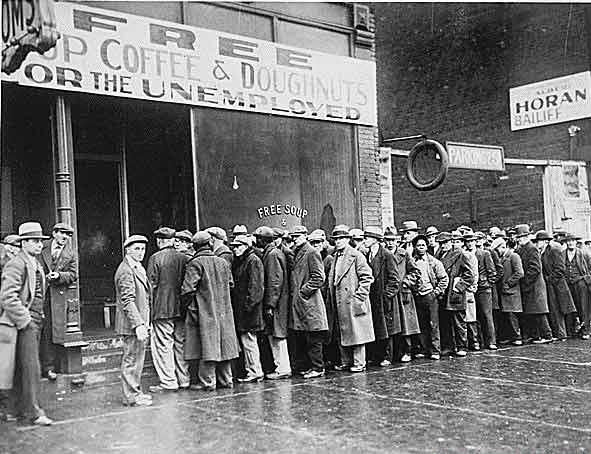
Keeping with the era of the Depression, “Brother Can You Spare a Dime” by Bing Crosby and Lenny Hayton is about the Great Depression blues too. This piece is different from “Gypsy Davy” in that it is not a fun and light hearted song in lyrics or music, it is a sort of blues song. Bing Crosby used the general tone of the time as the influence for the music. The tone of the song is dark and sad with a feeling of hope at certain points, mimicking the shattered dreams of Americans struck by poverty and unemployment. Crosby created this feeling of hope and then a let down by using minor scales and note combinations with several measures of major scales and groupings, making the listener hear and feel that positivity that so many people felt during the 1920s and after World War I, all to rip it away with a minor cadence and progression. He also uses a steady beat in the background of the part of the song where the singer is singing about working on a railroad and serving his country to drive home the point.
“Once I built a railroad, I made it run
Made it race against time Once I built a railroad, now it's done Brother, can you spare a dime?
Once I built a tower up to the sun Brick and rivet and lime Once I built a tower, now it's done Brother, can you spare a dime?”
The singer speaks of serving his country in the war, “building a dream” and asking “say don’t you remember? I’m your pal!” in contrast to what is happening to him now. Many Americans felt like their dreams had been taken from them after they had just served their country and trusted in the idyllic future of success and picket fences fed to them by the government since they now had to beg for dimes. So many Americans had to do exactly what this song says and beg for dimes to buy food for their families. Music is an agent of change as well as a healing agent because having someone you don’t know and who is a revered musician be able to identify with your struggle makes the world and your issue feel a little less doomed. This fits exactly with my point of music being tailored to the needs of its listeners. People needed this song to know that they weren’t alone in their struggles.
Junto song is another perfect example of how music serves as the unified voice for the people of its time. The original European song called “A Hunting We Will Go” is turned into a sort of cry of the colonials. The words were changed to “A Taxing We Will Go” as a jab at the crown for all of the harsh taxes imposed on those living in the new world. This is a prime example of how music was used as protest and to speak the minds of those who weren’t allowed to. The music it is set to is of the classic European style of the time with lots of instruments and classical progressions to keep the song close to people, as they were from Europe after all.
(https://www.huffingtonpost.com/2012/09/26/west-side-story-celebrate_n_1915570.html)
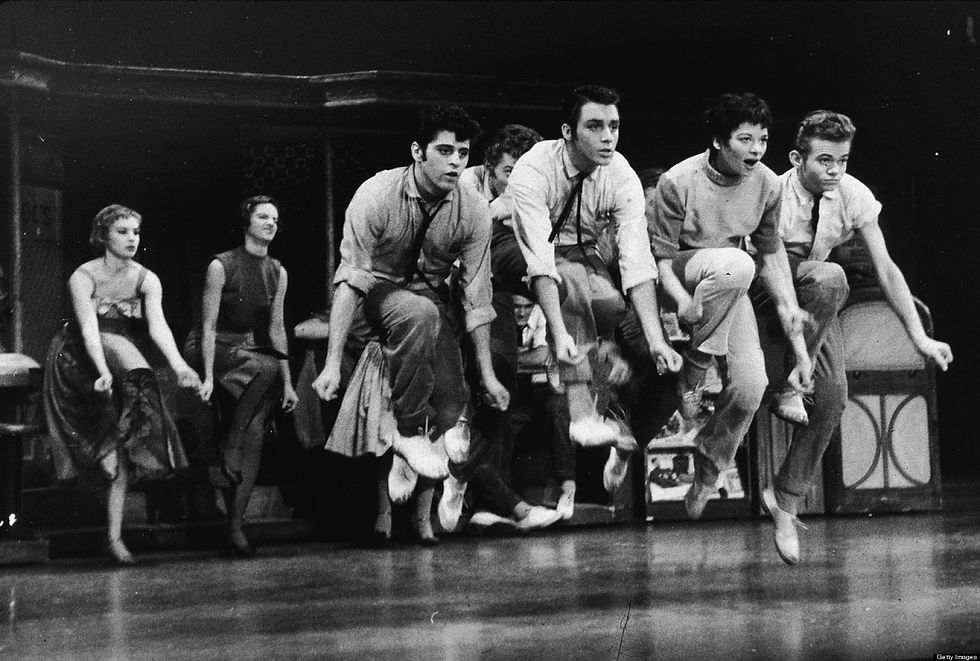
West Side Story was a political statement as much as it was a wonderful musical. With the general feeling of teen rebellion and post war tension, the musical hit on all of the social issues and feelings using gangs, Latin music, and fabulous choreography. With the rise of rock and roll, this time period was a clean slate for music, and Leonard Bernstein really used that to his advantage, combining Latin music and modern orchestral style to make a hybrid sound unique to the show. Going along with the theme of need, America was searching for stability and tensions were high after World War II, so racial issues and gang activity were running rampant as the country’s focus had been on winning the war for so long. People needed to see rebellion and their angst put into a tangible form such as a music with light hearted dance and singing. The subject of the song “Cool” is playing it “cool” even when all the characters want to do is fight. Their leader is telling them not to let their angst get the better of them and that was a message America needed to hear, even though it was part of a bigger musical work. This piece is an amalgamation of musical styles like minor riffs and blaring horns when the mood shifts.

(http://www.cnn.com/2015/12/18/opinions/garrett-star-wars-storm-troopers/index.html)
The last song I will mention that serves its time is the Imperial March by John Williams. Williams is arguably the most well known and respected composer of his time, having made multiple movies with Stephen Spielberg, George Lucas, and creating the score of the series of my generation, Harry Potter. One of Williams most iconic pieces is the “Imperial March” from Star Wars. This song is the theme of Darth Vader, the main villain in the series. This series is arguably the most iconic in cinematic history, spanning across decades and generations with the same message: rebellion against evil will prevail. The first film, A New Hope, came out in 1977, with tensions from Vietnam and the Korean War still high, people needed something positive and removed from reality. This theme represents the evil and darkness of the past decades and the lighter pieces such as the main theme can be interpreted as the positivity and the “good guys” theme. Williams scores make movies what they are and you would not be able to be transported to another galaxy without the major familiar melodies and dreamy harp progressions of his music. With the use of a full orchestra, Williams creates a powerful and sinister fast string dominated intro to “The Imperial March”, followed by horns, a symbol of strength, but with minor cadences and accompanied by an anxiety inducing backing melody of quick wind instruments. This piece is known by everyone and will always be affiliated with the greatest science fiction series of all time.
In conclusion, I want to point out how all of these pieces acted as cultural megaphones to the mouths of society. Some are more direct than others, for example “Brother Can You Spare A Dime” is a more blunt approach to connecting with social issues than John Williams Star Wars score, yet they both impacted their listener in a similar way. Music is very different now from 100 years ago in the way it sounds on the surface, but if you dig a little deeper, nothing has really changed apart from the instruments and language we use. Music has always been and will always be a form of social bonding where people who don’t know the artist or even each other, can sing along to or listen to and immerse themselves in a piece written by a stranger that reflects either the social and political climate, or maybe just the way that they feel. Technical approaches to music are quite consistent as well in that major and minor keys are still used to convey a general aura, forte and piano will always be tension and release, and though new progressions and textures are created, the concept is the same.
Sources
Anon, 2017. Woody Guthrie discography. [online] Wikipedia. Available at: <https://en.wikipedia.org/wiki/Woody_Guthrie_discography> [Accessed 29 Nov. 2017].
Anon, 2008. A Depression-Era Anthem For Our Times. [online] NPR. Available at: <https://www.npr.org/2008/11/15/96654742/a-depression-era-anthem-for-our-times> [Accessed 29 Nov. 2017].
Anon, 2017. West Side Story. [online] Wikipedia. Available at: <https://en.wikipedia.org/wiki/West_Side_Story> [Accessed 1 Dec. 2017].
Comments